
How to Drive Revenue and
Do Work That Makes You Proud
Order Now From
“One great value of Selling with Noble Purpose is how eminently practical it is. I strongly recommend for any manager or salesperson. It is right about the big picture. And it gets down to the nitty-gritty of how to make it happen in practice.”
Steve Denning
Forbes.com
Does Your Sales Force Have a Sense of Purpose?
(Or are you just selling stuff?)
For a double-blind study on sales performance, I recently shadowed hundreds of salespeople as they made their client calls. I made a significant discovery:
Salespeople Driven By A Sense Of Purpose
Wildly Outperformed Those Driven By Quotas.
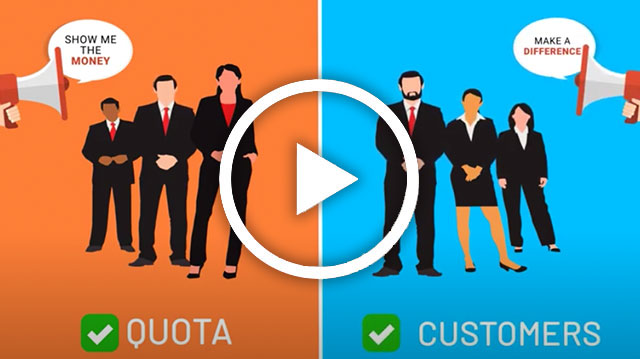
I observed that sales superstars didn’t look at their quotas and ask, “How can I meet them?” They looked at their customers and asked, “How can I help them?”
In most organizations, the top performers remain the same year after year, while the rest of the sales force stays stuck in the mediocre middle. What’s missing is a sense of larger purpose.
When you ask salespeople who are performing at an average level why they go to work, very few will give you an answer that sounds anything remotely like a sense of purpose. They usually just talk about money. But when you ask top-performing sales people why they go to work, they will almost always talk about having a larger “noble” purpose.
If you want your business development sales team to beat quota you must instill a sense of purpose in your sales force. That’s easier said than done, of course, but the dividends are too great not to try. Before I show you how to do that, let me introduce you to a few principles:
Business To Business Sales Training Principle #1:
Driving Revenue Is Not The Purpose Of A Sales Force.
It’s The Test Of Its Effectiveness.
Stellar performers don’t just “sell stuff.” They want to have an impact on their customer’s lives. They work harder and smarter because they have a sense of connection and meaning to their work that money alone doesn’t provide. Money isn’t a purpose; it’s the scorecard.
Targets, quotas, incentive programs, and bonuses produce short term spikes in performance from a small percentage of people. When salespeople are aligned and engaged with a higher purpose they will achieve far more sales.
Business To Business Sales Training Principle #2:
Overemphasizing Profit Erodes Your Bottom Line.
When leaders believe that their sole purpose is to produce profit, they view their customers as “its.” Customers are no longer human beings; they are anonymous targets and prospects whose sole purpose is to help the company make money.
When leaders talk about customers solely as a means to achieve their own goals, it radiates out to every single person in the organization. The internal conversation always becomes the external conversation. That kind of language creates a culture that says, “We don’t exist to do something for our customers; customers exist to do something for us.” People no longer care about helping customers; they just want to make money off them. And it’s only a matter of time before the customers start to feel it.
Sales Leadership Development Program Principle #3:
If You Treat Customers Like A Number They’ll Return The Favor
When the customer becomes nothing more than a number to you, you become nothing more than a number to the customer — and your entire organization suffers. When you over-emphasize financial goals at the expense of how you make a difference to customers, you make it extremely difficult for your salespeople to differentiate themselves from the competition. And the problem doesn’t stop there. It has a ripple effect on salespeople who:
- Start thinking only about the short-term
- Fail to understand the customers’ environment
- Cannot connect the dots between your products and the customer’s goal
- Cannot gain access to senior levels within the customer.
Then the problem escalates:
- Customers view you as a commodity
- You have little to no collaboration with them
- Customer place undue emphasis on minor problems
- Customer churn increases
- Contracts are constantly in jeopardy over small dollar amounts
- Sales strategy default response is to lower the price
- Sales has a negative perception in the rest of the organization
- There is little to no product innovation
- Turnover increases
- Sales team tries to game the comp plan
- Top performers become mid level performers
- Salespeople view their fellow salespeople as the competition
- Sales force morale declines
It’s not a pretty picture. When the internal conversation is all about money, the external conversation becomes about all money. And all of a sudden, that’s the last thing you’re making. Your sales team training starts teaching the wrong questions:
- How can we make our processes faster and cheaper?
- Which products are the most profitable?
- How can we make them more profitable?
- Which products are the least profitable? How can we change that?
- How much do our people cost?
- How can we generate more revenue with less people?
- How can we get each person to generate more revenue?
- What’s our promotion expense?
- How do our sales and marketing costs compare to the industry?
- How can we cut them?
- How can we get sales to produce more revenue?
- How can we get them to reduce expenses?
- How can make our people more efficient?
- What skills do they need to make us more profitable?
These are not bad questions to bring up in sales development training. However, they don’t prompt the kind of innovative customer-oriented thinking you need to differentiate your sales force or give you a competitive advantage.
Now, what would happen if sales leaders talked about customers as people they want to help rather than targets they want to close? How would that affect the sales force, and the customer service people? What impact would it have on customers?
Sales Management Consulting Principle #4:
Ask The Right Questions.
By shifting the conversation from meeting quotas to solving problems a purpose-driven sales executive tends to ask different questions:
- How do our processes impact our customers?
- How can we improve them to benefit our customers?
- What are our customers’ goals?
- What kinds of products would help them achieve those goals?
- How do our customers do business today?
- How might they do business in the future?
- How can our sales team help them get there?
- What problems do our customers encounter?
- How can we help them solve these?
- How can our sales training incorporate the customer’s environment?
Now, I ask you: If you were the customer, what set of questions would you want your sales person asking?
Executive Sales Training Principle #5:
Purpose-Driven Sales Forces Outperform Quota-Driven Ones.
Lest you have any doubt about the power of purpose, consider this: The data from a ten year growth study of more than 50,000 brands around the world show that companies who put improving people’s lives at the center of all they do outperform the market by a huge margin. The study, done by an independent consulting group in partnership with former Procter and Gamble CMO Jim Stengal, revealed that “those who center their business on improving people’s live have a growth rate triple that of their competitors, and they out-perform the market by a huge margin.”
Jim Collins and Jerry Porras of Good to Great fame documented as well that organizations driven by purpose and values outperformed the market by 15:1 — and outperformed comparison companies by 6:1
Sales Management Training Principle #6:
A Noble Selling Purpose Isn’t About You; It’s About Your Impact On Customers.
A Noble Selling Purpose (NSP) is not “We’re going to be the #1 provider of end-to-end solutions.” That’s your goal, and it doesn’t speak to how you make a difference in clients’ lives. An NSP isn’t about your desired position in the market. It’s about how you impact your clients today.
A Case Study In Sales Leadership Development
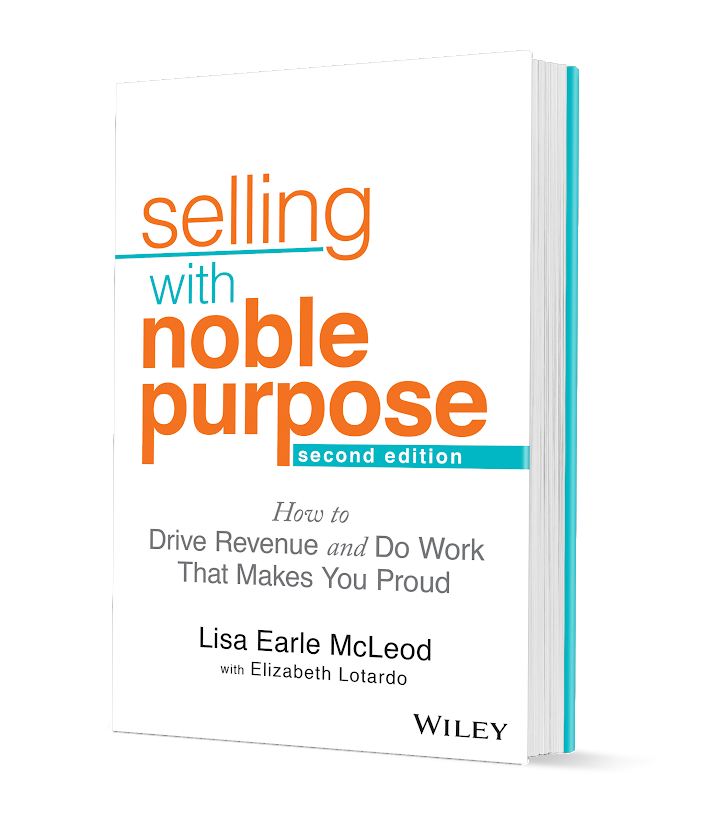
Let’s look at a company I profile in Selling With Noble Purpose, my sales leader training book: Graham-White. It’s a 90-year-old Virginia company with a long rich history of providing components to the transportation systems that millions of people depend on every day. Their sales people call on engineers and purchasing groups at customers like Amtrak, GE Transportation, Union Pacific, and New York Transit.
Graham-White’s tag line used to be: “We provide reliable transportation solutions.” It’s a good tag line, but it didn’t speak to the impact they have on customers. So we worked with their sales leadership team to reframe their tag line into a true NSP: “We help make transportation safer, faster and more reliable.”
The difference is subtle; it’s also significant. The first tag line described their products. Their new NSP describes the impact that their products have on the customers. Now instead of starting their sales calls with a description of their solutions, they begin by asking the customer questions about their environment, goals and challenges. This allows them to understand exactly what safety, efficiency and reliability mean to that particular customer.
VP of Sales Stewart Bruce says, “Moving to NSP shifted us from a product focus to a customer focus. It moved the conversation from cost to value, even with tough buyers like the purchasing department at GE respond differently.”
Graham-White uses stories about how they saved the brakes on a locomotive or kept trains running during a hard freeze substantiate their NSP. These compelling concrete examples show precisely how they really do make transportation safer, faster and more reliable. The company’s NSP approach has helped them win several million-dollar contracts, because they hone in on making it come alive for each individual customer.
How Noble Purpose Impacts
Business To Business Sales Training Programs
A noble purpose isn’t just a slogan you memorize or a mission/vision placard you keep in the lobby. Selling with noble purpose changes everything –from the way sales meetings are conducted to the way incentive programs are constructed. It elevates the thinking in sales coaching calls, and makes client presentations more powerful. And if you follow the advice in Selling With Noble Purpose, my sales leader training book, you’ll change your CRM screens so they prompt NSP questions for your sales team. You’ll also learn:
- Ten great NSP questions that drive better customer intelligence.
- How to use your CRM to sell with NSP.
- The 10 Second Game Changer (how to get in the right frame of mind immediately before a sales call).
- How NSP can eliminate turf wars.
- How to use NSP in sales coaching calls.
- Field coaching techniques before, during and after a sales call.
How To Incorporate Noble Purpose
In Your Sales Skills Training
In my sales management training book you’ll see how to infuse a noble purpose into every area of sales manager responsibility – Sales Meetings, Incentive Programs, Interviews, Presentations, and Pre-call coaching, amongst others. You’ll learn how to apply specific techniques for using your NPS in each of these areas, how to bring your NSP to life in sales meeting, and how use it during interviews to quickly identify top performers (and non-performers). You’ll learn how to reinforce your NSP with visual reminders, and how to coach sales people right before they begin an important call.
Selling with noble purpose shifts the conversation from cost to value, makes the link between your product and the customer’s need more concrete, captures critical business intelligence, provides access to senior management, identifies new opportunities, and closes bigger deals.
I teach people the art of selling business to business. I can tell you for a fact that quota-driven sign business reps, for example, simply sell signs to other businesses. The purpose-driven ones know that the day a sign goes up on a new business venture, owners get overwhelmed with emotion because it’s a visual representation of their deepest dreams. So they work harder and smarter because they want to validate people’s dreams.
I’ve done a lot of pharma sales training. I can tell you for a fact that quota-driven pharma reps simply sell drugs. Purpose-driven pharma reps save lives with the products they represent. They work harder and smarter because they want to save more lives.
I specialize in b2b sales training. I can tell you for a fact that quota-driven transit component reps, for example, simply sell services that dry compressed air for locomotives and rail transit vehicles. The purpose-driven ones get your daughter to her destination safely and quickly by making sure train brakes don’t lock up on frozen rail lines. The purpose-driven reps work harder and smarter because they know the value of preventing people’s lives from being disrupted.
Find out why business development sales leaders like Marshall Goldsmith (“Unique insights to drive revenue!”) believe in my sales coaching book. Click on any of the links below to order Selling With Noble Purpose, or if you’d rather have a conversation about infusing your sales force with its own noble purpose call or email us at 770-985-0760 or lisam@mcleodandmore.com.
Click the buy buttons today and start building a purpose driven sales force tomorrow.
Praise for Selling with Noble Purpose
In an era where most organizations believe that money is the only way to motivate salespeople, Selling with Noble Purpose offers a sustainable and exciting alternative.
“A must-read manifesto for anyone who is serious about sales leadership.”
Joseph Grenny, Author
Crucial Conversations
“If you sell based on deep mission and purpose, revenue will follow. As Lisa Earle McLeod explains in this remarkable book, you have to start with how to change another life. . then work back from that purpose.”
Tom Rath, Author
Strengthfinder 2.0
“McLeod has coached sales leaders at Apple, Kimberly-Clark, Pfizer, and other top organizations. She combines a wealth of field experience with unique insights to drive revenue.”
Marshall Goldsmith
#1 Leadership Thinker in the World
(Thinkers50 – Harvard Business Review)